561-532-2139

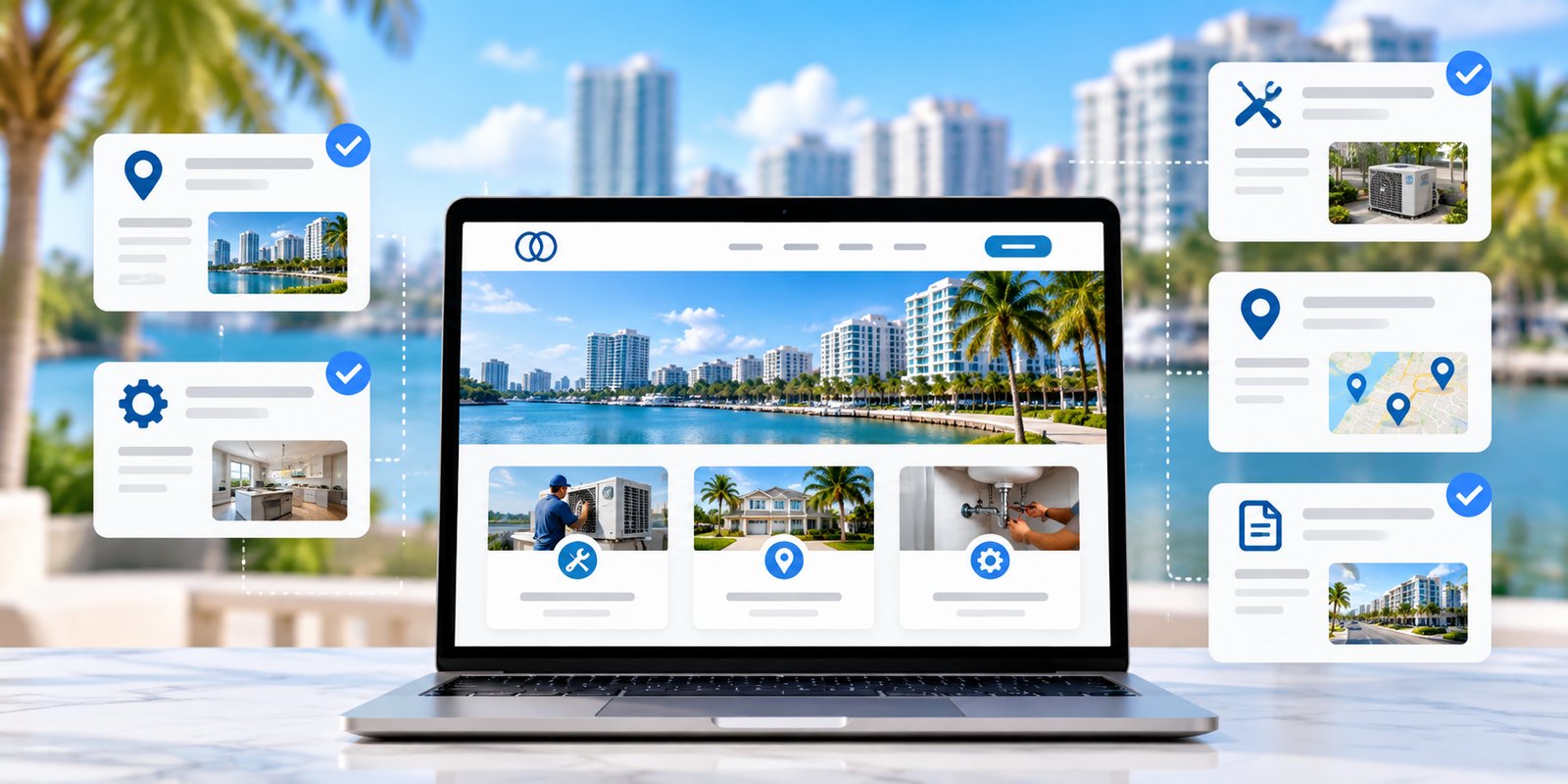

Local SEO often creates an important website-planning question: how many service and location pages should a business have?
It can be tempting to create a separate page for every service, nearby city, and keyword variation. More pages may appear to create more opportunities for visibility, but page count alone does not make a website more useful.
Each page needs a clear reason to exist.
A stronger Local SEO strategy in West Palm Beach starts with organizing the website around actual services, genuine service areas, and the different needs of local customers.
A service page should provide information customers specifically need about that offering. A location page should help customers determine whether the company genuinely serves their market.
When pages exist only to repeat slightly different versions of the same information, the website can become harder to use and more difficult to maintain.
1. Start With the Services Customers Actually Need
Before creating additional pages, make a list of the services the business genuinely provides and wants to promote.
Then look at those offerings from the customer's perspective.
Two services may sound different internally while customers view them as essentially the same thing. In other cases, services that appear closely related may solve different problems and deserve separate explanations.
Ask whether each proposed service page would answer meaningfully different questions.
Consider:
- Does the service solve a distinct problem?
- Does it involve a different process?
- Does it serve a different customer group?
- Are customer questions substantially different?
- Would someone deliberately look for that individual service?
- Can the business provide useful information specific to the service?
If the answer is mostly yes, a dedicated page may make sense.
If the page would simply repeat an existing explanation with slightly different wording, combining the topics may provide a better customer experience.
This can also give the website a clearer structure.
Instead of having several similar pages competing for a visitor's attention, customers can reach one strong page that thoroughly explains the service.
Related articles can then answer narrower questions without requiring another service page for every variation.
The goal is to make the site easier to understand rather than simply increasing the total number of pages.
2. Give Service Pages and Blog Articles Different Jobs
A service page and a blog article usually serve different customer needs.
A service page should explain what the business offers and help prospective customers decide whether the service is relevant to them.
A blog article can answer a narrower question someone may research before making contact.
For example, a local SEO service page may explain what the service includes, who it is for, and how a business can get started.
Related articles might explore topics such as business-information accuracy, location-page planning, customer reviews, citations, or other specific questions.
Keeping those roles separate makes the website easier to understand.
A service page can focus on:
- What the service is
- Who it is for
- What problems it addresses
- Important considerations
- How to get started
A blog article can focus on:
- One customer question
- One common mistake
- A comparison
- A planning issue
- A specific scenario
- A narrow decision factor
Businesses that want a broader view of local visibility can review Wellington Web Designs' local SEO services, while this article focuses specifically on deciding when separate service and location pages are useful.
That distinction helps visitors find the level of information they need without reading the same explanation across several pages.
3. Create Location Pages Only for Real Markets
Location pages can be valuable when a business genuinely serves more than one geographic market.
They become less useful when they are created only because a city name can be combined with a service term.
Start with the places that matter operationally.
A business can consider:
- Where current customers are located
- Where the company regularly provides service
- Which areas the business can realistically support
- Markets the company genuinely wants to develop
- Whether customer needs differ by location
- Whether useful local information is available for the page
For a business targeting West Palm Beach, a dedicated page can make sense when the company genuinely serves customers there and the location is important to its growth.
The same test should apply before additional city pages are created.
A location page should never imply that the company has a physical office, staff, partnership, or facility in a city when that is not true.
Service-area businesses can clearly explain where they work without pretending to have locations they do not operate.
Each location page should also help the customer answer something useful.
Can the company provide the service here? Which services are available? Are there relevant considerations for this market? How can the customer get started?
If a page cannot provide meaningful answers beyond changing the city name, it may not need to exist as a separate page.
4. Avoid Pages Built Only Around Slight Keyword Differences
A common website problem appears when businesses create several pages that target slightly different phrases but provide nearly identical information.
One page may use one service term while another uses a synonym. Several nearby city pages may share almost the same copy. The headings change, but the underlying information does not.
Before creating another page, ask one simple question:
What useful information would this page contain that does not already belong on an existing page?
If there is no clear answer, the topics may be better combined.
This does not mean a website should have as few pages as possible.
It means every page should have a purpose.
A strong service page can often explain several closely related terms naturally without requiring a separate URL for each wording variation.
Fewer, stronger pages can also simplify maintenance.
When services change, contact information is updated, or the business expands, there are fewer repetitive pages that need to be corrected.
That can make the website easier for both the business and its customers to use over time.
It also reduces the chance that someone will encounter two nearly identical pages and wonder which one contains the most current information.
5. Connect Related Pages With Useful Internal Links
Once the right service and location pages exist, internal links can help visitors move between related information.
A blog article about one local topic can direct readers to a relevant service when they want to learn more.
A service page can point toward an educational article when a customer needs additional detail about a specific issue.
Links between related pages can make the website easier to explore without forcing one page to explain everything.
Anchor text should make the destination understandable.
A descriptive phrase gives visitors a clearer idea of what they will find after clicking than a generic phrase such as “click here.”
Businesses should not add internal links simply to increase the number of links on a page.
The destination should genuinely help the visitor continue their research.
Useful connections may include:
Blog articles linking to related services
Service pages linking to helpful educational resources
Related service pages connecting when the relationship is relevant
Broader service pages guiding visitors toward more specific information
Contact pages providing a clear next step
Wellington Web Designs also provides broader SEO and digital services for businesses that need support beyond one local search topic.
The purpose of internal linking is to help visitors find useful related information, not to make pages feel overloaded with links.
6. Review the Page Structure as the Business Changes
The website structure that makes sense today may not remain the right structure several years from now.
Businesses evolve.
They add services, discontinue offerings, enter new markets, change priorities, and publish more content.
Website structure should evolve with those changes.
A periodic review can ask:
- Does every service page still represent a real offering?
- Are two pages now saying almost the same thing?
- Are important services difficult to find?
- Are location pages still accurate?
- Does every geographic page represent a real market?
- Are older pages still useful to customers?
- Are related pages connected in a way that makes sense?
Sometimes the right decision is to create a new page.
In other cases, two older pages may be clearer when combined.
A service that once appeared as a small part of another page may become important enough to deserve its own destination. A location the business no longer serves may no longer justify a dedicated page.
The objective is to keep the website aligned with the current business rather than preserving every page indefinitely.
A well-organized website does not need a separate page for every possible phrase.
It needs useful pages for the services and markets that genuinely matter.
Businesses can also review Wellington Web Designs' local SEO services to learn more about improving local visibility through clearer website content and business information.
Companies that want to review their current website structure and local search presence can contact Wellington Web Designs to request a Free Consultation.
Frequently Asked Questions
Does every service need its own SEO page?
No. A separate service page is most useful when the offering has distinct customer needs, questions, or information. Closely related services can sometimes be grouped when one combined page provides a clearer experience.
Should every city I serve have its own location page?
Not necessarily. A location page should represent a real market the business serves and provide useful information for customers there. Creating separate pages for nearby cities without meaningful differences can result in repetitive content.
What is the difference between a service page and a blog post?
A service page explains what the business provides and how a prospective customer can take the next step. A blog post generally answers a narrower informational question related to that service.
Can too many similar pages create problems?
Yes. Several pages covering nearly identical topics can make the website repetitive and harder for visitors to navigate. A clearer approach is to give each important topic one strong page and use related articles for narrower questions.
How often should service and location pages be reviewed?
There is no fixed schedule, but pages should be reviewed whenever services, geographic coverage, or business priorities change. Periodic reviews can also identify duplicate, outdated, or unnecessary pages.