561-532-2139

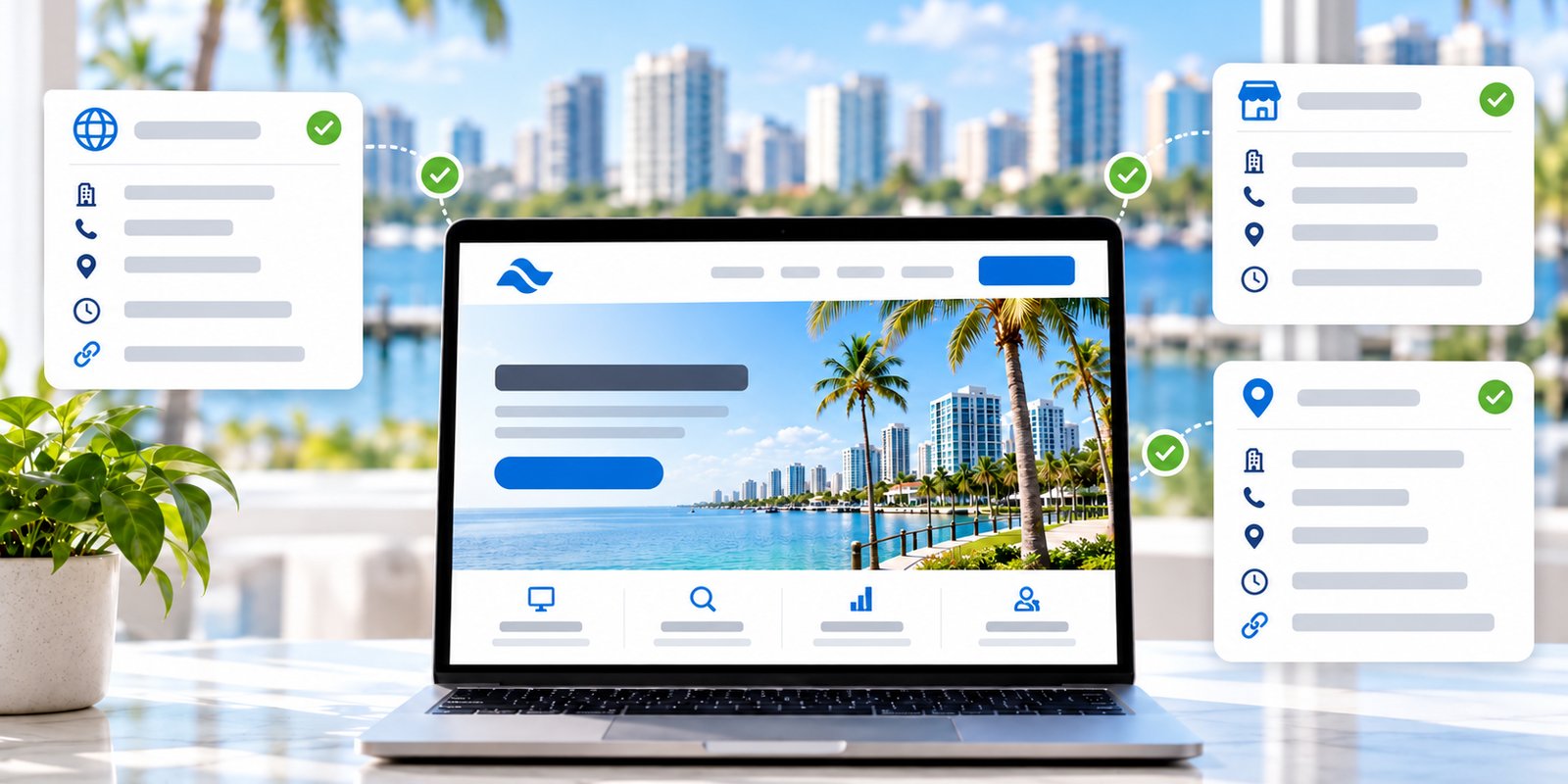

Local customers may encounter a business in several places before they ever make contact.
They might first see a Google Business Profile, visit the company website, open a directory listing, review a social profile, or find another local reference. Each of those sources can influence whether the business appears current, relevant, and easy to reach.
Problems begin when those sources disagree.
One profile may display an old phone number. Another may show outdated hours. A directory could point to a previous address or describe services the company no longer provides.
A stronger Local SEO strategy in West Palm Beach includes making sure the essential information customers find online accurately reflects the business.
The goal is not to make every description identical. It is to make sure the facts customers rely on remain accurate wherever the business appears.
1. Start With the Details Customers Rely On Most
Not every piece of business information carries the same importance.
The details that deserve the most attention are usually the ones customers use to decide whether they can reach, visit, or hire the company.
These commonly include:
- Business name
- Phone number
- Website
- Physical address, when applicable
- Service area
- Business hours
- Main services
- Contact options
A customer who finds two different phone numbers may hesitate before calling either one.
Someone who sees conflicting business hours may decide not to visit at all.
A service-area business with outdated geographic information may receive inquiries from customers it no longer serves while missing people in markets it now covers.
That is why local business information should be treated as active information rather than something that is entered once and forgotten.
Businesses change.
Phone systems are replaced. Offices move. Hours change. Service areas expand. New services are introduced while older offerings are discontinued.
Whenever those changes occur, the website is only one of several places that may need attention.
Start by confirming the information on the company website. Because the business controls that site directly, it can serve as a reliable reference point for the information published elsewhere.
A well-organized website also makes it easier for customers to verify what the business offers, where it operates, and how to get in touch.
2. Compare the Website With the Google Business Profile
For many local searches, a Google Business Profile may appear before a customer reaches the company website.
That makes consistency between those two sources especially important.
Review the company name, phone number, website link, hours, address or service area, and the services being emphasized.
The wording does not need to match exactly.
A website may provide detailed service pages while the Google profile uses shorter descriptions. What matters is that both sources accurately represent the same business.
Inconsistencies often appear after routine business changes.
A company may update its operating hours on the website but forget to change the Google profile. A new phone number might be added to one source while an older number remains on another.
Service information can drift as well.
If the website emphasizes one set of services while the profile appears to describe a different version of the company, prospective customers may be unsure about what is actually available.
Reviewing the website and Google Business Profile together can help identify those gaps.
The website can provide detailed explanations about services, locations, and the company itself. The Google profile can provide quick access to important local details.
When both sources agree on the essential facts, customers have a clearer path from discovery to contact.
Businesses reviewing their broader online presence may also find Wellington Web Designs' article on building local brands through trusted web design useful when considering how website clarity and local credibility work together.
3. Review Major Directories and Older Listings
Business information can remain online for years.
A directory profile created long ago may still appear in search results even when no one at the company remembers setting it up.
That is where outdated citations can create confusion.
A citation is an online reference to a business and may include details such as the company name, phone number, address, or website.
Businesses do not need to pursue every obscure listing they can find.
It is more useful to begin with sources customers are realistically likely to encounter or that are relevant to the company's industry and local market.
These may include:
- Established business directories
- Mapping platforms
- Local chambers
- Professional associations
- Industry-specific directories
- Community or local business resources
When reviewing those sources, look for:
- Old phone numbers
- Previous addresses
- Incorrect website links
- Duplicate profiles
- Outdated business names
- Incorrect hours
- Services that are no longer offered
- Categories that no longer fit the business
Duplicate profiles deserve particular attention.
A customer may discover two different listings for the same company and have no way to know which one is current.
Older listings can also create problems after a company moves, changes its branding, or updates its service area.
The purpose of maintaining these listings is not simply to increase the number of websites where the business appears.
It is to make the information customers can already find more accurate and useful.
4. Keep Service and Location Information Current
Phone numbers and addresses are not the only details that can become outdated.
Services and geographic coverage can change too.
A company may begin serving West Palm Beach but fail to update older profiles. Another business may stop covering a certain area while directories continue to suggest that it does.
Service information can create the same type of problem.
If a listing promotes a service that is no longer available, customers may contact the company for something it cannot provide.
If a new priority service appears on the website but not on important local profiles, the broader online presence may no longer reflect the current business accurately.
Review location information from the customer's point of view.
Is there a physical location customers can visit?
Is the company a service-area business that travels to customers?
Does it work only in West Palm Beach, or does it serve additional communities?
Those answers should remain clear across the website and major profiles.
Businesses should also avoid claiming broader geographic coverage than they can genuinely support.
Local visibility is more useful when it reflects real operations.
The same principle applies to services.
Online profiles should emphasize what the business actually offers and wants customers to find rather than preserving every service that has appeared in an older listing.
Accurate service and location information can help reduce irrelevant inquiries and give prospective customers a clearer idea of whether the company fits their needs.
5. Create a Simple Process for Keeping Information Updated
Consistency becomes easier when the business has a simple system for maintaining its core information.
Without one, even small changes can spread unevenly.
A new phone number may be updated on the homepage but missed on the contact page. Business hours may change on Google while an important directory still shows the old schedule. A new service may appear on the website but not on another profile customers use.
A simple reference list can help.
It might contain:
- Current business name
- Preferred phone number
- Main website address
- Current physical location or service area
- Standard business hours
- Key services
- Links to important profiles
When a major detail changes, use that list to identify the places that need attention.
Start with the website and Google Business Profile, then review directories, industry profiles, and local resources that matter most to the business.
Periodic checks can also catch problems that were not caused by a recent company change.
How often those reviews are needed depends on the business.
A company with stable information may require only occasional checks. A business that is expanding, moving, changing services, or updating its brand may need more frequent reviews.
The objective is not perfect uniformity across every website online.
The priority is making sure the sources customers are most likely to use provide accurate information about the company.
Businesses that are also updating the structure, messaging, or usability of an older website can review the small business website redesign checklist for additional areas that may need attention during a broader website update.
6. Think of Consistency as a Customer Experience Issue
Business-information consistency is often discussed as a local search topic, but it is also a customer-experience issue.
People use online information to make real decisions.
They decide whether to call, where to go, when a business is open, and whether the service they need appears to be available.
Incorrect information creates friction before the business has an opportunity to speak with the customer.
Imagine finding a company through Google and then seeing a different phone number on its website.
Which one should you call?
Or imagine confirming business hours online, arriving at the location, and discovering that the schedule has changed.
Those experiences can affect confidence even when the mistake was accidental.
Accurate information removes unnecessary uncertainty.
It also allows different parts of the business's online presence to work together.
A customer may discover the company through search, visit the website, read an article, return through Google, and then contact the business.
The important details should remain recognizable throughout that journey.
Consistency does not mean repeating identical marketing copy across every platform.
The website can provide detailed explanations. A directory can provide a short business summary. A Google Business Profile can make local information easy to access.
They simply need to agree on the facts customers depend on.
For West Palm Beach businesses, maintaining accurate information across those sources is one practical way to make the online customer experience clearer.
Businesses that need broader support with their website and search presence can review Wellington Web Designs' SEO and digital services.
Companies ready to discuss their current website and local visibility can also contact Wellington Web Designs to request a Free Consultation.
Frequently Asked Questions
What business information should stay consistent online?
The most important information usually includes the business name, phone number, website, physical location or service area, operating hours, and core services. These details should accurately reflect the business wherever customers are likely to encounter them.
Does every business listing need exactly the same description?
No. Descriptions can vary based on the platform and available space. The important requirement is that the underlying facts about the business, services, location, and contact information remain accurate.
What should I do if an old directory has outdated information?
Start with important directories and sources customers are likely to use. Update or correct the listing when possible. If duplicate profiles exist, determine whether the platform provides an option to claim, merge, or remove outdated entries.
Why do business hours matter for local visibility?
Accurate hours help customers understand when the business is available and reduce confusion when they find the company online. Hours should be updated whenever regular schedules or important availability details change.
How often should local business information be reviewed?
There is no single schedule for every business. Information should be reviewed whenever the company changes its phone number, location, hours, services, website, or service area, along with periodic checks of major profiles and directories.